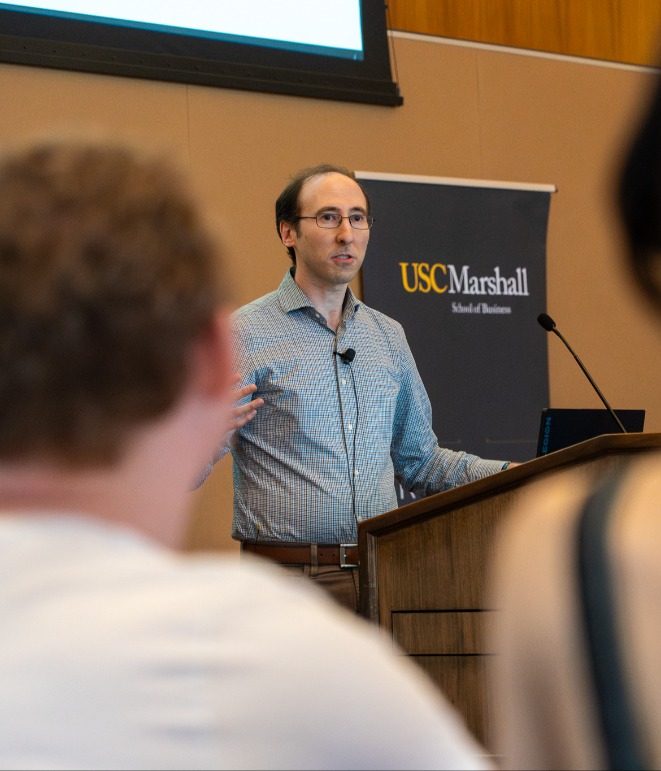
On Friday, five Marshall faculty members presented findings at the school’s annual Research Fair. Topics ranged across disciplines, including artificial intelligence, managerial approaches, banking, data analysis, and even vehicle trade-ins.
“In these times, it’s particularly important that we affirm what we do, what we stand for,” said Peer Fiss, associate vice dean of research, in his opening remarks. “And of course, so much of what we do is creating new knowledge and sharing that new knowledge. And the fair is very much in that spirit.”
As Fiss told an audience of students, staff, and fellow faculty members, the featured research extended beyond the theoretical and into practical applications.
“The research presented here today, as you’ll see, is not at all abstract,” Fiss said. “It’s really stuff that’s very practical and has impact for scholars, for practitioners, for policymakers, for our students, and that’s what I think makes this [Research Fair] particularly attractive.”
John Eklund, assistant professor of management and organization, delivered on Fiss’ promise of real-world relevance with his presentation, “Losing the Forest for the Trees: How Managerial Attention Can Make or Break Organizations.” Eklund’s work centered on attention drivers within executive teams, and whether managers should keep their focus narrow or adopt a broader perspective.
“Organizations have a vast array of different internal stakeholders that push the attention of the organization in different directions, which can lead to very different outcomes,” Eklund said. “Attention is really important. What you pay attention to ultimately is what an organization will implement and carry out. So what you pay attention to is what grows.”
Jacob Bien, professor of data sciences and operations, used his presentation, “Learning From Data Without Fooling Yourself,” to explore how assumptions and data set incompatibility can result in faulty experimental conclusions.
“A lot of the questions that really matter are actually small effects and noisy situations,” Bien said. “And so I like to quote another physicist … Richard Feynman says, ‘The first principle is that you must not fool yourself, and you are the easiest person to fool.’”
In her presentation, “Money and Banking,” Giorgia Piacentino, associate professor of finance and business economics, partially explored the origins of banks, which date back to ancient warehouses in Mesopotamia, Egypt, Japan, and Europe.
Fiss praised the presentations, highlighting how essential it was for attending faculty, especially, to see their colleagues’ groundbreaking work.
“One of the things I believe that makes this special is that it’s an opportunity to learn about what your colleagues do,” Fiss said. “We don’t always have that opportunity … Having five different departments present and learning what our colleagues are doing is particularly attractive.”
For more information about the Research Fair’s presentations, please visit the fair’s official page.