2026 USC Marshall Research Fair
Scholars will present their latest research on the impacts of new technology on February 27, 11:30 a.m.–2:00 p.m. in the Ronald Tutor Center Forum Room.
Marshall Faculty Presenting at the 2026 Research Fair.
[USC Graphic]
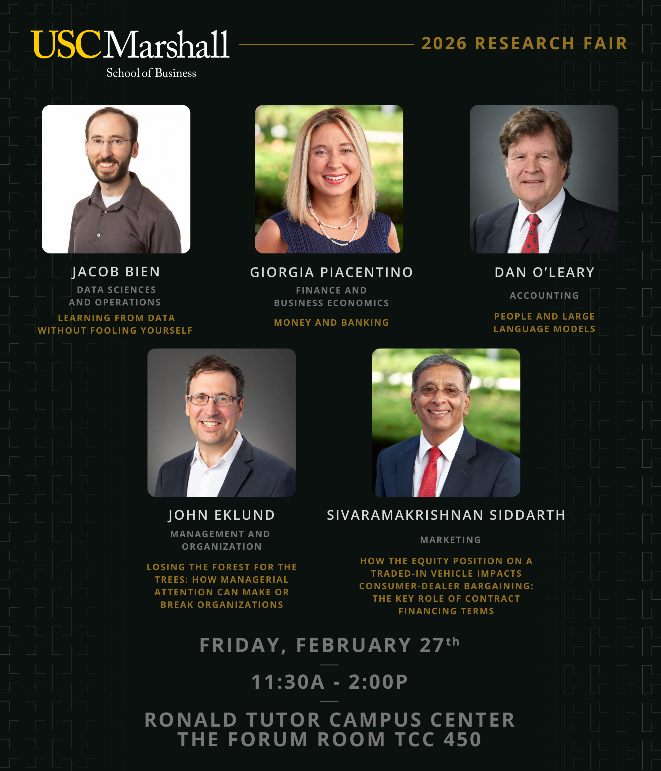
Five scholars from across USC Marshall departments will present new research at the 2026 Research Fair on February 27, 2026, from 11:30 a.m.–2:00 p.m. in the Ronald Tutor Center Forum Room at USC.
Established in 2016, the Research Fair provides a forum to learn about and discuss recent and engaging research by Marshall’s world-class faculty. To support broad engagement, the Research Fair is presented in a hybrid format, allowing participants to attend in person or online.
This year’s participants continue to share their pathbreaking research that takes a deep dive into top issues impacting business and society. From improving sequential decision-making to financial intelligence to how social perceptions affect product success, these topics and others showcase the forward-thinking approach of Marshall faculty.
“The Marshall Research Fair promotes interdisciplinary engagement and the sharing of new research ideas, but just as importantly the application of these ideas to business practice and the dissemination of knowledge beyond academia,” said PEER FISS, associate vice dean for research at Marshall and the Jill and Frank Fertitta Chair of Business Administration and professor of management and organization.
Following are the research titles and summaries each faculty member will discuss in order of their scheduled appearance:
“Learning From Data Without Fooling Yourself”
Jacob Bien, Professor of Data Sciences and Operations
The field of statistical machine learning provides data scientists with two parallel streams of tools. The first consists of wonderfully flexible tools for data exploration and ideation: What are the patterns in my sales data? Can I find distinct subgroups of customers based on their characteristics? How are key metrics of my business changing over time? The second stream offers tools for careful decision-making and quantifying uncertainty: Am I confident that a new website design actually increases sales? What is the margin of error for my projected profit this month?
These two important streams, however, are fundamentally incompatible. The statistical methods in the second stream are predicated on the assumption that hypotheses were precisely articulated before looking at the data. In other words, if you discovered an interesting pattern during data exploration, you have invalidated the traditional tools for quantifying uncertainty. Failure to appreciate this incompatibility is one of the primary explanations for the “replicability crisis” that has plagued many fields over the last few decades.
We are now in an era that has wholeheartedly embraced algorithmic, data-driven exploration. Thus, it is essential to develop statistical tools that properly quantify uncertainty while accounting for prior data exploration. In this talk, I will discuss new methods we have developed to bridge this divide, allowing data scientists to fully leverage a single data set for both exploration and validation without being led astray.
“Losing the Forest for the Trees: How Managerial Attention Can Make or Break Organizations”
John Eklund, Assistant Professor of Management and Organization
One of the most valuable resources firms possess is their managers’ attention. In a fast-changing world with ever-increasing demands on individuals’ attention, firms must be judicious about the issues to which their managers pay attention. Pay attention to too many issues, and managers risk overloading their organizations chasing fools’ gold, wasting valuable resources in the process. Focus too narrowly, however, and managers may miss significant opportunities or important trends that could derail the firm if not addressed promptly.
I will present a recent survey of my research on managerial attention, focusing on four recently published papers. First, I show that the issues to which managers pay attention can have important implications for how securities analysts value their firms. Second, I discuss how managerial attention to new technology is a necessary but not sufficient condition for firms’ investing in the technology; attention must be followed by action. Third, recognizing that firms are not unitary actors, managers will often pay attention to different things, I examine how firms can reconcile divergent attentional patterns to produce coherent actions. Finally, I explore the breadth of strategic attention of senior managers and the tension they must balance between ensuring they are aware of a broad opportunity environment while avoiding attentional overload where nothing ultimately gets done.
“People and Large Language Models”
Daniel E. O’Leary, Professor of Accounting
In this presentation, I will review results examining interactions between large language models (LLMs) and humans, along with an analysis of several human-like behaviors of LLMs. As part of my recent research, I have investigated biases associated with the use of LLMs, studied human biases reflected in LLMs, and analyzed the ability of LLMs to capture and measure human sentiment, among other issues. I have conducted experiments involving direct interaction between people and LLMs and analyzes of LLMs. Those experiments have led to several findings, where on average,
• People are biased by responses from LLMs.
• Like people, LLMs have an anchoring bias.
• Like people, LLMs have a confirmation bias.
• LLMs can have a specificity bias, providing direct number estimates, even when the direct estimates have a low probability of occurrence.
• In general, LLMs provide “better than human” estimates of positive and negative sentiment about text.
• However, LLMs can also provide different estimates of sentiment to the same text at different times.
• LLMs can exhibit a “no one is good enough (or bad enough) bias,” ignoring ends of sentiment measure number spectrums (e.g., less than .1 or greater than .95).
• Like people, LLMs exhibit an ostrich effect, ignoring information. In this presentation I also examine some implications of these findings for different applications.
“Money and Banking”
Giorgia Piacentino, Associate Professor of Finance and Business Economics
What is a bank? How did banks emerge? Why is bank debt redeemable on demand, even though it makes them subject to runs? Should policy makers intervene to foster financial stability?
The neoclassical economic model cannot address these questions, because everything is perfectly allocated in frictionless markets. To address them, we need models in which fundamental frictions, like limits to commitment or imperfect information, give rise to banks, demandable debt, and financial instability.
This talk is an overview of some of my work taking this approach. I first explain the origin of banks from around the world, from repositories of, e.g., grain in ancient Egypt, rice in Japan, gold in England, and even tobacco in the early US. Then I explain how banks’ circulating warehouse receipts became a form of circulating private money, which were necessarily redeemable on demand. That makes them subject to runs. So financial fragility is a necessary cost of money creation. There is no panacea, even in theory. I conclude with a discussion of how policy makers can think about this trade-off.
“How the Equity Position on a Traded-in Vehicle Impacts Consumer-Dealer Bargaining: The Key Role of Contract Financing Terms”
Sivaramakrishnan Siddarth, Professor of Marketing
Consumers who acquire a new durable good often trade in their currently owned product during the purchase process. The equity position of these consumers depends on how much of the loan used to acquire the trade-in, if any, has been paid off, and how much the used product has depreciated. Some consumers may be "upside down" in their trade-in, with the vehicle valued lower than the outstanding loan amount. Others may have a positive equity position, with trade-in market value exceeding the amount owed, and many may have paid off their loan completely.
How do these different equity positions affect the deals consumers get when buying their next car? In this talk, I examine how trade-in equity shapes bargaining outcomes—not just on the sticker price, but also on the financing terms that often go unscrutinized. Using data from thousands of new car transactions, I find that consumers in a negative equity position face a significant disadvantage, but perhaps not where you might expect. These buyers do not pay higher prices for their new vehicles. Instead, they receive substantially worse financing terms. The result is striking: dealers earn roughly twice as much profit from financing when selling to negative-equity consumers compared to those with positive equity. I discuss what these findings mean for car buyers, manufacturers, and policymakers concerned with consumer protection.