2025 USC Marshall Research Fair
2025 USC Marshall Research Fair
Scholars present their latest research on the impacts of new technology — February 28th from 11:30 a.m.–2:00 p.m. in the Ronald Tutor Center Grand Ballroom.
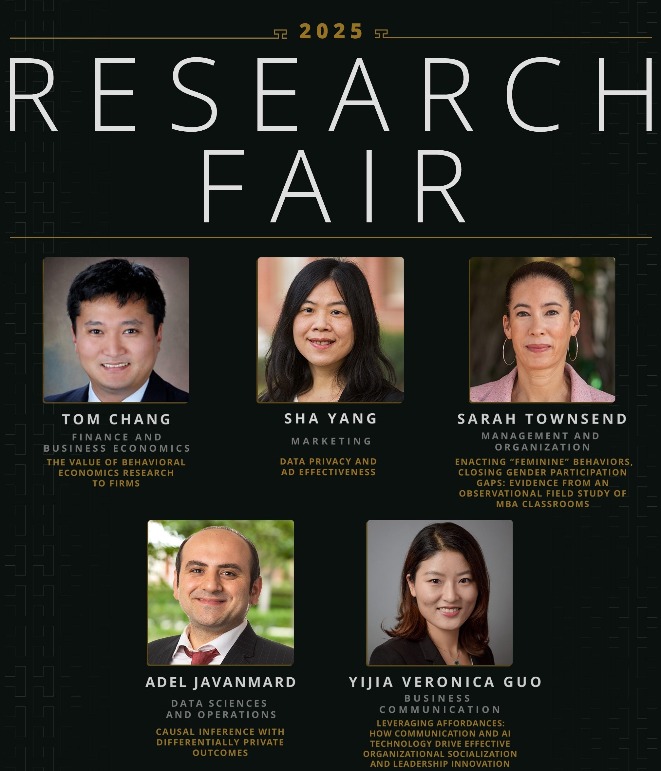
Marshall Faculty Presenting at the 2025 Research Fair [USC Graphic]
Stay Informed + Stay Connected
Five scholars from across USC Marshall departments will present their recent work at the 2025 Research Fair, to be held February 28, 2025, from 11:30 a.m.–2:00 p.m. in the Ronald Tutor Center Grand Ballroom located on USC’s University Park campus.
The Research Fair, originated in 2016, is an opportunity to hear about and discuss some of the most recent and engaging research developed by Marshall’s world-class faculty. To ensure broad access, the Research Fair is presented in a hybrid format, allowing participants to attend in person or online.
This year’s participants continue to share their pathbreaking research that takes a deep dive into top issues impacting business and society. From improving sequential decision-making to financial intelligence to how social perceptions affect product success, these topics and others showcase the forward-thinking approach of Marshall faculty.
“The Marshall Research Fair promotes interdisciplinary engagement and the sharing of new research ideas, but just as importantly the application of these ideas to business practice and the dissemination of knowledge beyond academia,” said PEER FISS, associate vice dean for research at Marshall and the Jill and Frank Fertitta Chair of Business Administration and professor of management and organization.
Following are titles and summaries of the research each faculty member will discuss, in order of their scheduled appearance:
"The Value of Behavioral Economics Research to Firms"
TOM CHANG, Associate Professor of Finance and Business Economics
Much of business school research aims to provide valuable insights for companies and policymakers seeking to improve their decision-making. Beyond just policy evaluation, economics, along with other social sciences, attempts to understand the core underlying factors of a situation to generate broadly applicable and externally valid recommendations – essentially, provide good advice. A common belief in behavioral science is that many issues can be effectively and cost-efficiently addressed through individual-level interventions. A well-known example of this is nudge theory, which posits that small changes in the choice environment can lead to significant changes in individual behavior. Published research often reports effect sizes large enough to imply that firms could meaningfully benefit from implementing such interventions. But what little research there is exploring the performance of interventions published in academic research “in-the-wild” have generally found disappointingly modest results.
Over the past few years, using a combination of pragmatic randomized controlled trials and other robust causal research methods, I have explored the extent to which nudges and other insights from the academic behavioral sciences literature can improve the delivery of
healthcare in a county managed health system. In this talk, I present the results of some of these efforts.
"Data Privacy and Ad Effectiveness"
SHA YANG, Professor of Marketing
As concerns about data privacy grow, governments have introduced laws to protect consumer information, and companies are adopting new practices to safeguard user data. Our research explores how these privacy measures impact the effectiveness of digital advertising. In the first study (forthcoming in Journal of Marketing), we examine what happens when companies reduce the length of time they track consumer behavior online. We focus on multi-product display ads—advertisements that showcase several products at once—and analyze how shorter tracking periods influence consumer engagement. Our findings show that when companies collect less behavioral data, they present fewer product options in ads. This lack of variety makes ads feel repetitive, leading to fewer clicks and lower advertising revenue for online platforms. The second study (the Job Market Paper of a Marshall PhD student) looks at the balance between personalized ads and privacy concerns. Using Apple’s Limit Ad Tracking (LAT) feature, which restricts behavioral tracking on iPhones, we analyze how consumers respond to targeted ads when privacy protections are in place. We find that while many consumers prefer ads that match their interests, they also dislike excessive data tracking. Our research introduces a new approach to ad targeting that better balances personalization and privacy, benefiting consumers, advertisers, and digital platforms alike. Together, these studies highlight the need for thoughtful policies that protect consumer privacy without undermining the effectiveness of digital advertising. We encourage businesses, policymakers, and tech platforms to find solutions that respect user privacy while ensuring ads remain relevant and valuable.
"Enacting “Feminine” Behaviors, Closing Gender Participation Gaps: Evidence from an Observational Field Study of MBA Classrooms"
SARAH TOWNSEND, Associate Professor of Management and Organization
Record numbers of women have enrolled in graduate business programs—a path to greater career prospects. Yet gender disparities in grades and career outcomes persist. Why might this be? Historically, business schools have been male-dominated and characterized by masculine defaults. That is, these cultures regard characteristics associated with the male gender role (e.g., being assertive and competitive) as neutral, necessary, or standard. Given that these contexts prioritize masculine defaults, we investigate a potential consequence by examining gender disparities in a critical aspect of students’ experiences: classroom participation. In an observational field study of 3159 students across 76 MBA classrooms, we find a gender participation gap in actual student participation behavior. Specifically, comparing students’ expected participation based on their representation with their actual participation, we find that men (vs. women) disproportionately participate in classroom discussions. Importantly, however, our findings also indicate that this gap is not inevitable. Using thin-slice impressions of professors’ behaviors during classroom interactions, we find that when professors diverge from the masculine default by exhibiting “feminine” behavioral cues (e.g., warmth, thoughtfulness, and likability), there is a reduction in the gender participation gap. In a follow-up empirical study, we replicate this reduction in the gender participation gap when participants imagine being in a classroom with a professor who exhibits feminine behavioral cues. Further, we find that increased feelings of inclusion among women partially explain this reduction in the gender gap. Our findings highlight that, even in historically male-dominated settings, leaders’ subtle behavioral cues have the potential to create more equitable spaces.
"Causal Inference with Differentially Private Outcomes"
ADEL JAVANMARD, Professor of Data Sciences and Operations
Estimating causal effects from randomized experiments is only feasible if participants agree to reveal their potentially sensitive responses. Of the many ways of ensuring privacy, label differential privacy is a widely used measure of an algorithm’s privacy guarantee, which might encourage participants to share responses without running the risk of de-anonymization. Many differentially private mechanisms inject noise into the original data-set to achieve this privacy guarantee, which increases the variance of most statistical estimators and makes the precise measurement of causal effects difficult. There exists a fundamental privacy-variance trade-off to performing causal analyses from differentially private data. With the aim of achieving lower variance for stronger privacy guarantees, we develop a novel differential privacy mechanism, which leverages any given cluster structure of the data while still allowing for the estimation of causal effects. We show that, depending on an intuitive measure of cluster quality, we can improve the variance loss while maintaining our privacy guarantees.
"Leveraging Affordances: How Communication and AI Technology Drive Effective Organizational Socialization and Leadership Innovation"
YIJIA (VERONICA) GUO, Associate Professor of Business Communication
In today’s fast-evolving business landscape, workplace communication is increasingly mediated by cutting-edge technologies, from social media platforms to advanced Generative AI tools like ChatGPT and synthetic human-like avatars (SHS avatars). How are these tools shaping organizational communication and leadership effectiveness? My research explores the dual-edged impact of technological affordances—the unique opportunities and challenges these tools present—and how they influence workplace communication and performance, particularly in two critical contexts: onboarding new talent and executive leadership communication.
Social media affordance—visibility, editability, persistence, and association—plays a pivotal role in shaping employee behavior. Entry-level employees use these features to curate professional impressions, navigate power dynamics, foster cross-cultural adaption, and manage boundaries between personal and professional identities. Yet, these same affordances can constrain employees by amplifying vulnerabilities and creating tensions between organizational expectations and individual autonomy.
Leadership is a design problem. Looking ahead, Generative AI technologies may advance media affordance with their transformative features. Gen AI affords leaders opportunities to design their image and identities, engage with target audiences, and enhance communication efficiency. However, they also risk triggering skepticism and trust issues among employees for the leadership, underscoring the need for transparency and strategic implementation.
In my presentation, I will talk about the dual nature of technological affordance in organizational socialization and leadership. Businesses can design organizational and leadership communication to foster innovation, inclusivity, and growth by leveraging communication technologies.