EDIT

AI for Business Summit Forecasts Future of AI in Industry

AI for Business Summit Forecasts Future of AI in Industry

Founders, faculty members, and students spoke of balancing new technology integration with human-first workplaces at the first BUAI summit.
02.17.26
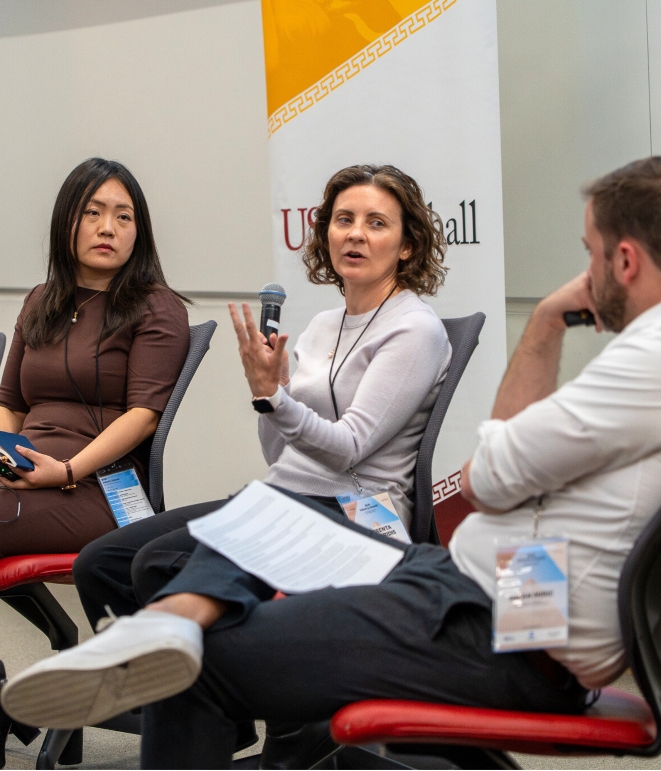
Florenta Teodoridis, Nan Jia, Milan Miric, and Andrew Ogilvie speak on a panel at the summit.

[L to R] Nan Jia, Florenta Teodoridis, and Milan Miric speak at the BUAI Industry Summit.

[USC Photo / Alex Bernard]

Stay Informed + Stay Connected

MARSHALL MONTHLY BRINGS YOU ESSENTIAL NEWS AND EVENTS FROM FACULTY, STUDENTS, AND ALUMNI.

On February 6, USC Marshall’s AI for Business (BUAI) program hosted its first BUAI Industry Summit, bringing together students, faculty, and leaders from emerging markets for discussions on the professional and pedagogical integration of new technology. 

Marshall Dean Geoffrey Garrett opened the summit with recorded remarks emphasizing the significant role BUAI plays in preparing students for an ever-shifting professional landscape.

“We all know that BUAI already is an incredible program,” Garrett said. “It’s not only incredible on campus, it’s incredible because of its connectivity to industry. So this summit is a celebration of that and something that’s going to turbocharge our industry engagement.”

Many of the students in the room were current or aspiring entrepreneurs who merge business acumen with technical expertise. Bei Zhang, the vice president and growth at Tanka AI, explained how his company supports founders by pairing them with AI agents. Through extensive development, Zhang said AI will have the capability to adapt to and, eventually, anticipate a business’s tailored needs.

“AI will have the level of intelligence to think, to infer, to reason, to go beyond what you might not be asking the AI to do, but by guessing where the paths might be heading,” Zhang said. “We’re working on building proactiveness into the agent.”

While Zhang spoke of enabling AI’s potential, Ted Rouhani, an investor in nxtlinq, described how his company uses blockchain technology to put guardrails around AI initiative. As Rouhani explained, nxtlinq requires that AI agents submit tokens to gain permission to execute certain actions. Without the permissions encoded within the token, the AI is barred from performing the function.

Rouhani said that technology like nxtlinq protects against the non-human aspects of technology, which have no fear of consequences.

It’s not just about using [AI] to substitute everything. I think that we still need to value humanity and also how humans can improve the performance of AI.

— Bowen Lou

Assistant Professor of Data Sciences and Operations

“Software doesn’t fear getting arrested. It doesn’t fear going to jail. It doesn’t fear getting exposed,” Rouhani noted. “The whole ultimate goal of the software is to continue to learn and push the boundaries. Without these guardrails, this technology can go from being something extremely productive to something extremely risky, especially in an enterprise environment.”

As companies increasingly adopt AI agents, many people express concerns about job displacement. Despite advancements, panelists stressed the importance of balancing proficiency with humanity.

“AI literacy is very important, and people need to have some general idea about the benefit and challenge of AI and to think about how AI can improve — especially instilling the value of humanity to develop data,” said Bowen Lou, assistant professor of data sciences and operations. “I think that’s very important. It’s not just about using [AI] to substitute everything. I think that we still need to value humanity and also how humans can improve the performance of AI.”

Nan Jia, professor of management and organization, echoed Lou’s point in her research presentation, adding that AI can only be as effective as its compatibility with professional teams.

“AI adoption in the workplace is not just a substitute,” Jia explained. “How much value we can unlock using AI — it’s not just a matter of the technology. The same technology can create vastly different organizational performances depending on how you pair it up with the teams.”

Beyond discussions and panels, attendees established connections with industry insiders, observed a showcase of student projects and startups, and networked with visiting business and technology professionals.