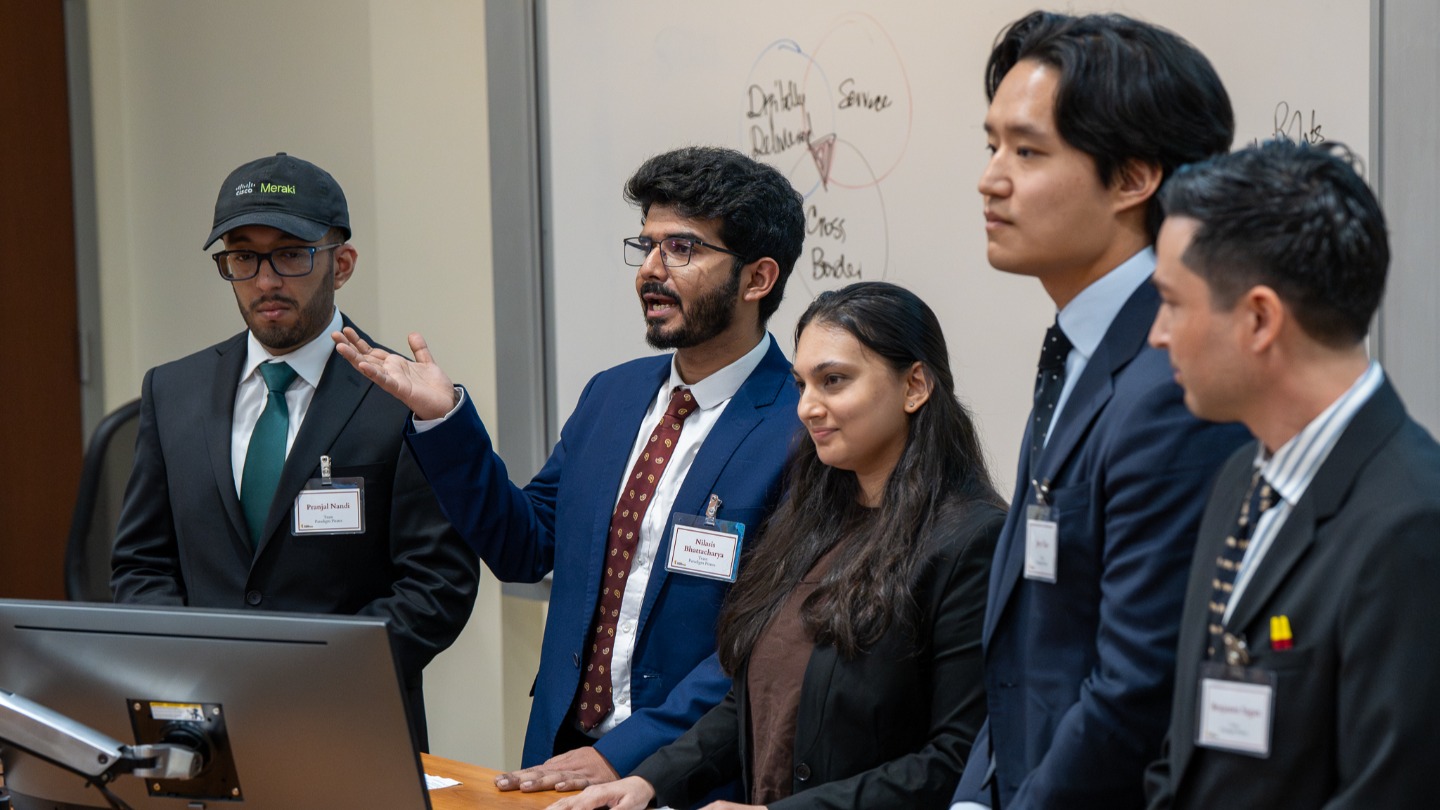
On March 6, USC Marshall’s team of Full-Time MBA (FTMBA) students won the Global Case Competition. Hosted by USC Marshall for over 20 years and held in Popovich Hall, the competition brought together top business schools from across the globe, including the Hong Kong University of Science and Technology, University of California, Berkeley, Carnegie Mellon University, Washington University of St. Louis, and UCLA. The winning team from Marshall, nicknamed the “Paradigm Pirates,” was awarded a $10,000 prize for their presentation on the integration of Google AI into travel booking, titled “Commerce, Reimagined.”
Google served as the competition’s corporate case sponsor and provided students a prompt in early February. Financial supporters of the case competition included Deloitte, McKinsey & Co., Northern Trust. Each team presented a bold, actionable strategy to address the rise of AI-driven agentic commerce while retaining the trust of Google’s vast user base.
At the competition, participants presented a 15-minute pitch that incorporated real-world consumer analysis and laid out their strategy. Judging panels were composed of faculty members and industry insiders and were kept blind to each team’s school affiliations. The judges scrutinized proposals during 10 minutes of Q&A.
In their presentation, Marshall’s winning team developed methods for simplifying the travel booking process through AI assistance. To ensure the depth of their proposal, the team leveraged their personal networks and USC connections to solicit feedback and guidance from Google project managers. Employing those responses, the group showed judges how automated price comparisons and personalized recommendations on Google could increase usage and repeat customers.
Team member Nilasis Bhattacharya, an MBA student in the Class of 2026 and president of the Marshall High Tech Association, says the team’s depth of financial analysis and seamless demo helped them stand out from a competitive field and secure their place in the finals.
Most of all, however, he believes the team’s camaraderie propelled them to victory.
“I think what made the difference in this case competition was both the diversity of our team and the unique strengths each person brought to the table,” Bhattacharya said. “Through this experience, I got to work with people who, if I were starting my own venture tomorrow, would be the first I’d call. I’ve made lasting connections here, and this win is something we’ll remember forever.”
For Bhattacharya, the competition offered professional lessons as well. He described how Google’s case required his team to raise their game, deliver on a tight deadline, undergo intense scrutiny, and do it all under pressure. Most of all, it required them to step up and take center stage.