
How Funding Sources Shape Venture Survival
A new study from Associate Professor Shon Hiatt examines the impact of a refugee influx on Jordanian entrepreneurs.
How to Talk with Your Hands
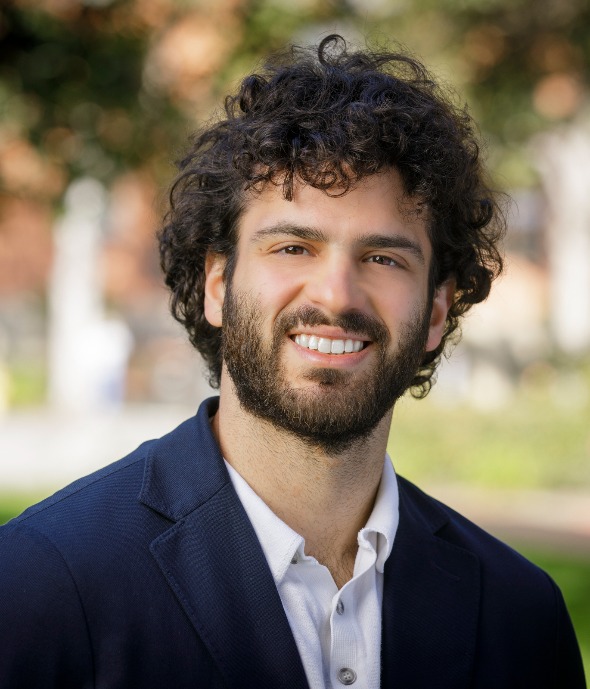
New research led by USC Marshall’s Luca Cascio Rizzo reveals that gestures that visually represent what speakers say help audiences perceive them as more competent and persuasive.

[iStock Photo]
When you’re leading a meeting, teaching a class, or pitching an idea, you probably focus on what to say. But what you do with your hands can be just as important.
In a new study published in the Journal of Marketing Research, Luca Cascio Rizzo, assistant professor of marketing, along with Jonah Berger, professor of marketing at the Wharton School, and Mi Zhou, professor of information systems at the University of British Columbia, examined how hand gestures influence communication. Analyzing thousands of TED Talks and conducting controlled experiments, they found that the right kind of gestures—those that illustrate what a speaker says—make people appear clearer, more competent, and more persuasive.
“People often talk with their hands,” Cascio Rizzo explained. “But how they move matters more than we realize.”
Gestures do not merely add emphasis—they help translate ideas into visual form. When a speaker traces an upward curve to describe growth or shows distance with their hands, they create a mental image that helps the audience grasp abstract concepts. This visual reinforcement increases cognitive fluency—how easily information is processed—which in turn enhances perceptions of competence.
The researchers used AI-driven video analysis to identify and classify different types of hand movements in over 2,000 TED Talks. Speakers who relied more heavily on illustrators—gestures that depict what is being said—received significantly higher audience evaluations and engagement. Follow-up laboratory experiments confirmed the causal link: audiences consistently rated gesturing speakers as more competent and persuasive because they made the content easier to understand.
Importantly, not every hand movement has a positive effect. Gestures that simply highlight words or movements that do not carry meaning can distract from the message.
“The key is intentional motion,” Cascio Rizzo said. “Gestures should clarify, not clutter.”
This distinction underscores that effective communication is multimodal, combining words and movement in a coordinated system. When those channels align, the message feels seamless and credible.
The findings have practical implications for anyone whose success depends on clear communication. Whether presenting quarterly results, teaching a concept, or sharing a new strategy, speakers can enhance their impact by aligning hand movements with their message. In today’s environment—where communication often happens through video calls and digital platforms—gestures remain a powerful tool.
“In mediated settings, attention is limited,” Cascio Rizzo noted. “Gestures give structure to speech and make explanations easier to follow. That clarity can be the difference between being heard and being understood.”
People often talk with their hands. But how they move matters more than we realize.
— Luca Cascio Rizzo
Assistant Professor of Marketing
For managers and educators, the takeaway is simple: train not just for what to say, but for how to say it. Intentional gestures can reinforce key points, increase audience retention, and make speakers appear more confident and capable. The research also highlights that audiences often infer psychological traits from physical behavior, meaning that body movement can subtly shape impressions of competence.
Cascio Rizzo’s research is among the first in marketing to integrate large-scale video analytics with controlled experimentation to study body movement at scale. By applying multimodal AI tools, the team demonstrates how data science can shed new light on nonverbal behavior.
“Marketing has long examined what people say,” he explained. “We’re showing that how they move while speaking can be just as revealing about how influence works.”
The work contributes to USC Marshall’s growing leadership in the study of communication, technology, and behavior—fields that intersect in the modern marketplace. As hybrid work, online presentations, and AI-mediated communication become more common, understanding how people move while speaking may prove as critical as understanding what they say.
RELATED
How Funding Sources Shape Venture Survival
A new study from Associate Professor Shon Hiatt examines the impact of a refugee influx on Jordanian entrepreneurs.
The Geography of Opportunity: What Happens When We Scale Up Neighborhood Policies
New research by USC Marshall’s Diego Daruich and the University of Texas at Austin’s Eric Chyn explores what happens when small-scale housing and neighborhood programs are expanded citywide — and what it means for reducing inequality.
The Driverless Future is Coming. Will a Safety Net Follow?
With the rise of driverless cars like Waymo, Assistant Professor Georgios Petropoulos analyzes how legislation could provide a safety net for workers impacted by the growing market.
Why “Inefficient” AI Spending May Power Future Growth
New research finds companies investing heavily in new technologies despite low returns are often the ones driving tomorrow’s economic progress.
Op-Ed: Luca Cascio Rizzo in Fast Company
Cascio Rizzo explains how his research links purposeful hand gestures with perceptions of competence.