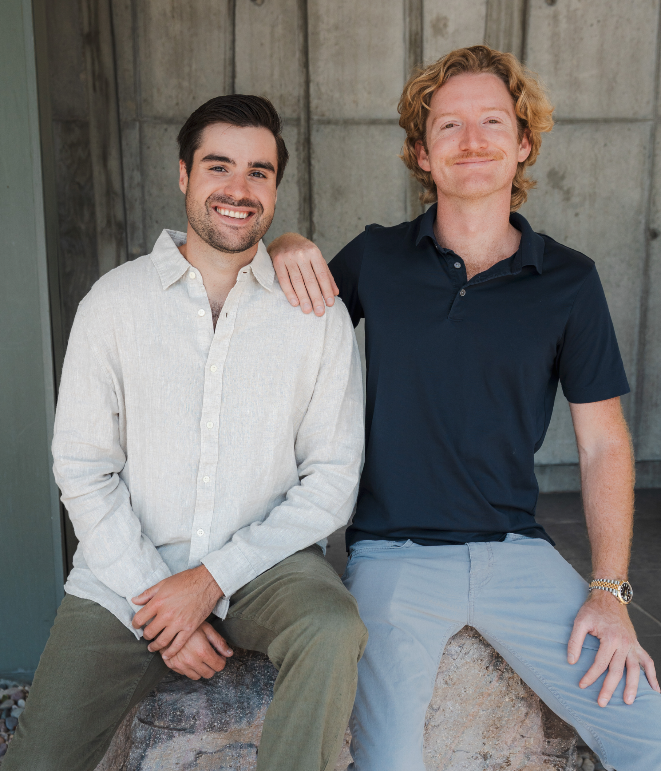
With a small sum of revenue at their disposal, they had a window to build a new company that could last. Yet, their next idea came not from a broad market analysis but from a few simple trips to the grocery store.
As they worked to generate a new venture, Alfieri often made pasta on the small office stovetop, the pair making routine journeys to the sauce aisle to pick up necessary ingredients. Bonde and Alfieri eventually grew bored of the same basic tomato sauce week after week. That’s when inspiration struck.
“We started thinking about what if somebody did what’s been done in beverage with a bright, colorful, exciting, cheeky brand and paired it with real meaningful innovation that would allow a brand to separate itself on the product end, but also communicate more value to the consumer and ideally build more loyalty,” Bonde recalled.
Sauz was born. Working with food scientists, Bonde and Alfieri relied on their own tastes to develop innovative flavors distinct from traditional sauce brands. They aimed for their company to be unapologetically Gen Z and Californian, decorating their jars with colorful, eye-catching labels.
Eventually, the fledgling startup received its first order from Erewhon, where for six months, Bonde and Alfieri incorporated customer feedback to adjust the recipe and improve each successive Sauz batch. New flavors became a hit, and jars flew off the shelves at stores and farmer’s markets. Sauz earned shelf space at major grocery chains and eventually won a contract at Target over several major sauce brands.
For the founders, the Target deal represents a seminal moment for the company, serving as validation for Bonde and Alfieri’s down-to-earth attitude toward the sauce business. The business partners note they don’t take flavor inspiration from Michelin star restaurants in coastal cities, but from mainstream brands with mass appeal, such as Buffalo Wild Wings, Wingstop, and Chick-fil-A.
“In between L.A. and New York, we have this blank slate of opportunity to make a product that resonates more so to the shopper in Toledo than anybody ever has in our category,” Bonde said. “[We] allow them to buy up into premium but do it in a way that really resonates on their palette.”
Bonde and Alfieri have engaged their customer base on multiple fronts, from their vibrant graphic design to irreverent online presence. Today, Sauz is sold in over 7,000 stores nationwide and grows with each passing month.
As they’ve expanded their business, Bonde and Alfieri have leaned into their USC education and network. Through Harris Smith, a retired adjunct professor at the USC Leventhal School of Accounting, they identified and partnered with Sauz’s first co-manufacturer, without whom there may be no company today. Bonde also reflected on an entrepreneurship class in which he was able to connect with a guest speaker about advertising strategy.
“Something about USC that I think is so unique is the ecosystem that professors and faculty and staff and students breed in the classroom,” Bonde said. “I think that’s the foundation that is so often spoken about at USC, but you don’t really know if you’re ever going to put it in practice. And we have countless examples of just the way the USC family [was there for us].”
Looking back on their time before and after graduation, the friends-turned-business-partners hope USC students follow in their footsteps, taking the leap and building the plane on the way down.
“We always took the risk,” Alfieri said. “Coming right out of college, those are the times when you really can risk it. You might be 35 years-old and might not have as much risk with kids or something like that. When we were starting Sauz, we were like, ‘This is our time to do it. We just have to go for it.’”