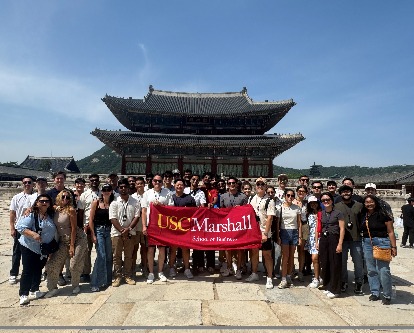
USC Marshall School of Business Launches Asia Executive Advisory Board to Strengthen Global Partnerships
Distinguished leaders gather from across Asia to guide strategic expansion and deepen regional engagement.
USC-India Innovation Summit Strengthens Ties
President Folt, Dean Garrett, and USC leaders traveled to India to promote win-win opportunities for educational collaboration between the world’s two largest democracies.
Marshall Dean Geoff Garrett and Dean Saravanan Kesavan of BITS School of Management stand on stage at the USC-India Innovation Summit.
[USC Photo]
India is growing, and not just in population. According to BMI COUNTRY RISK AND INDUSTRY RESEARCH analysts, India will be the world’s fastest-growing large economy over the next 10 years. The South Asian giant’s rapid development is thanks, in part, to its young population, business-friendly reforms, rapidly improving infrastructure, and exciting TECHNOLOGICAL ADVANCEMENTS that are including hundreds of millions of Indians in the country’s dramatic economic progress.
Galvanizing the university’s long history of deep connections in India and the opportunities for a win-win collaboration between the world’s two largest democracies, the University of Southern California recently hosted the USC INDIA INNOVATION SUMMIT in Mumbai, India’s financial capital and the engine of much of its growth. President Carol Folt, Dean GEOFF GARRETT of the Marshall School of Business, Dean Elizabeth Daley of the School of Cinematic Arts, Dean Yannis Yortsos of the Viterbi School of Engineering, and other USC senior leaders joined with alumni, students, parents and friends as well of business, government, and cultural leaders on January 16 in Mumbai to participate in presentations and panel discussions focused on areas of innovation and collaboration between USC and India.
In addition, Marshall also signed an important MOU with a new high quality business school in India. On the morning of the summit, Dean Garrett and Saravanan Kesavan, Dean of the BITS School of Management (BITSoM) penned an agreement centered on promoting research collaboration, graduate and undergraduate student exchanges, and the exploration of possibilities for dual degrees between the two schools.
“India is vital to USC Marshall’s mission to prepare business leaders for an increasingly complex global economy full of exciting opportunities and daunting challenges,” Dean Garrett said. “Our new partnership with BITSoM encourages academic cooperation between two of the world’s most dynamic business schools at a time when India is blossoming and India-US ties are rapidly deepening and strengthening.”
The signing was followed by a keynote address by former Los Angeles Mayor and United States Ambassador to India Eric Garcetti. Garcetti’s speech underlined the powerful bonds between the United States and India that he said are founded on four core principles: peace, prosperity, planet, and people.
During the summit, NICK VYAS, founding director of the RANDALL R. KENDRICK GLOBAL SUPPLY CHAIN INSTITUTE (GSCI), led a panel discussion focused on diversifying the United States’ global supply chain by supporting India’s manufacturing and shipping pathways in light of rising political tensions with China.
“We tackled India’s journey towards becoming an economic powerhouse,” Vyas said. “We explored the current challenges and opportunities, with a particular focus on the supply chain, trade, and attracting foreign investments.”
Dean Garrett also moderated a discussion on how American universities can collaborate with peer Indian institutions at a time of dynamic change and the opening up of India’s higher education sector.
Our new partnership with BITSoM creates exciting opportunities for academic cooperation between two of the world’s most dynamic business schools at a time when India is blossoming and India-US ties are rapidly deepening and strengthening.
— Geoff Garrett
Dean
“The United States must fundamentally change its view of India, recognizing it not only as a source of labor but also as a vital innovation partner,” Vyas said. “Higher education may shift this mindset by encouraging strategic academic collaboration and knowledge sharing, for instance through joint research initiatives.”
The country’s role at Marshall is already significant. There are currently more than 300 Indian students studying at both undergraduate and graduate levels. That number doubles if students of Indian origin are taken into account. At Marshall’s Global Supply Chain Institute alone, one in every five students hails directly from India.
Karsh Malhotra, a first-year master’s student in Global Supply Chain management who attended the summit was drawn to Marshall from New Delhi because the business school would push his education far beyond the textbook through real-world learning.
“When you come to Marshall, you realize that knowing why you do it is more important than just learning through the books,” Malhotra said. “It’s not just about math and algebra; it’s also about how you communicate. It’s about how you manage the efficiencies in your company. How do you handle model obligations, and how do you handle ethical conundrums?”
RELATED
USC Marshall School of Business Launches Asia Executive Advisory Board to Strengthen Global Partnerships
Distinguished leaders gather from across Asia to guide strategic expansion and deepen regional engagement.
Artificial Intelligence Can Help New CEOs Drive Innovation
New research shows AI can be a strategic catalyst for innovation and creativity, especially during leadership transition.
AI Bottlenecks: A Q&A with Georgios Petropoulos on Obstacles to an Economic Boom
Assistant Professor Georgios Petropoulos discusses his research on artificial intelligence bottlenecks and the factors preventing the technology from catalyzing an economic surge.
Energy Business Summit Explores Impact of AI and Shifting Policy Landscapes
From mining and metals to hydrocarbons and finance, industry leaders share insights on emerging challenges and opportunities in the energy sector.
Faculty Perspectives: New Rules for Effective and Responsible AI Use in Academic Research
Research from Assistant Professor Nofar Duani and her co-authors explore effective, ethical uses of generative AI in surveys and experiments.