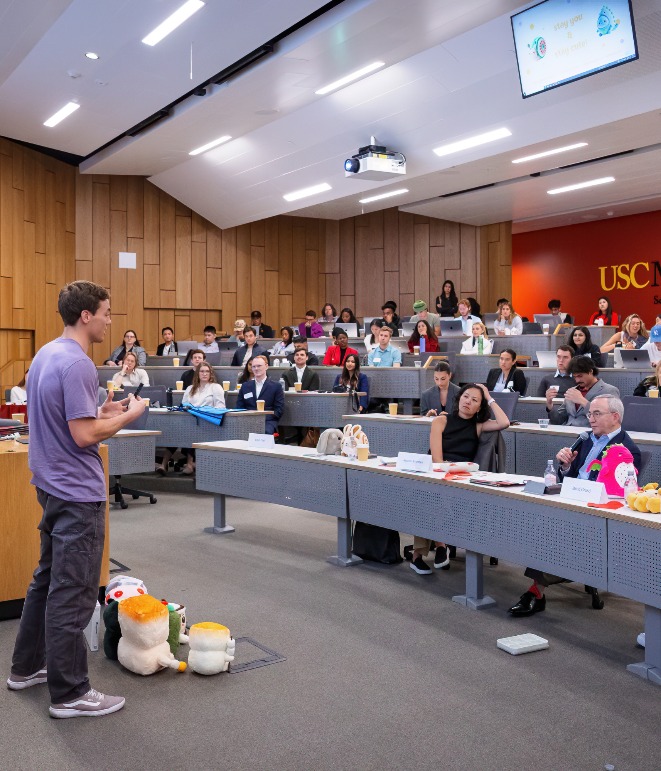
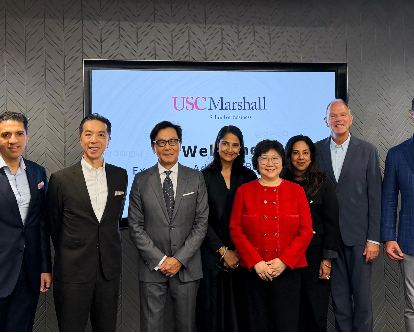
On April 25, six companies competed for over $160K in prizes at the annual New Venture Seed Competition (NVSC). Hosted by the Lloyd Greif Center for Entrepreneurial Studies, the finals were held at Fertitta Hall.
Michael Schumacher ’23 and his company, but cute, a membership-driven plush toy company won the NVSC Platinum Prize (first place). Schumacher is a graduate of the Master of Science in Entrepreneurship and Innovation (MSEI) program at the USC Marshall Greif Center and an avid toymaker.
“Growing up I was a super anxious kid and struggled with negative self-talk,” Schumacher said.
Plushies helped quell his anxieties. As he got older, the avid toy collector grew tired of mass production and wanted toys that better represented people’s biggest insecurities.
“Plush toys are scientifically proven to reduce stress and anxiety,” Schumacher said.
Schumacher created his company, but cute, a world of over 300 characters from a place called Quirklandia who are perfectly imperfect. Looking forward, Schumacher hopes to build beyond his limited edition plush toy club and grow the business through storytelling that can be leveraged into coloring books, puzzles, and more. For now, Schumacher said the company is booming with Gen Z collectors and tapping into a booming adult collectibles toy market.
“I love this brand because it’s ever expandable. I love the world-building, character designing,” Schumacher said.
Zement, founded by Kilian Ashley, a PhD candidate at USC Dornsife School of Letters, Arts and Science, won the Gold Prize of $20K for its low-carbon, high-strength concrete alternative that helps meet demands of new legislation while mitigating the negative impacts of the concrete industry across the globe.
Ashley, who is studying at the department of earth sciences and working with a robust team of diverse researchers, said, “2.5 gigatons of CO2 is released every year by the concrete industry. New legislation has mandated a change to our industry — a 40% emissions reduction by 2035.”
Ashley cited the opportunity — an $819 billion global market for ready-mix concrete and an innovative revenue model that provides carbon capture systems to customers at no cost to them initially. The material they are using, zeolite, was used in structures like Rome’s Colosseum.
“Every single one of our team members cares about the climate crisis and creating real world solutions that can create an impact today,” Ashley said. “Using Zement, we can create communities that are more resilient to the future, in rebuilding L.A. and beyond.”