USC Marshall’s Next Chapter: A Conversation with Interim Dean Andy Call
In this Q&A, Dean Call shares his key priorities and the importance of community in shaping Marshall’s future.
Croatian Prime Minister Delivers Global Economics Talk at USC Marshall
Prime Minister Andrej Plenković spoke to students, faculty, and staff about the state of Croatian economics, investing in innovation, and shared advice for students interested in global politics.
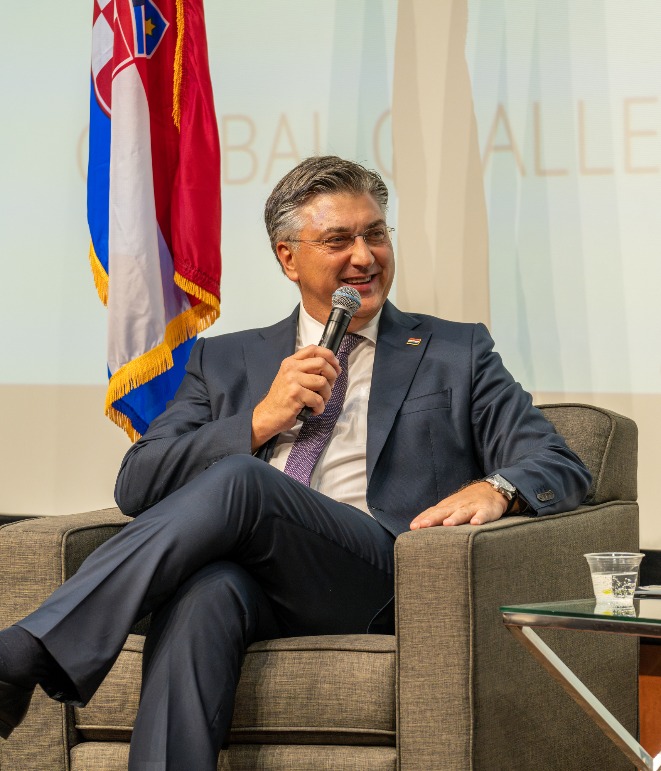
Croatian Prime Minister Andrej Plenković speaks with students and faculty.
[USC Photo / Grayson Adler]
Croatian Prime Minister Andrej Plenković spoke at the USC Marshall School of Business on September 24, addressing faculty, staff, and students on the global economy, Croatian trade and tourism, and the lingering effects of the COVID-19 pandemic. The remarks and ensuing discussion took place in the Edison Auditorium in Hoffman Hall on University Park Campus.
Plenković, the longest serving prime minister in Croatia’s post-independence history, has overseen the country’s development in the year following its accession to the European Union in 2013. He also served during the COVID-19 pandemic and the subsequent period of trade and supply chain disruptions. Despite the challenges, he sees tremendous progress in Croatia’s world standing.
Now in his third term as prime minister, Plenković is seeking to address four key priorities: demographic deficits (i.e. shrinking populations); decarbonization; digitalization; and investment in education.
“Croatia today is among the 38 most advanced economies. It’s the 18th tourist destination in the world. It’s the eighth [ranked] country in fulfilling the obligations of the sustainable development goals, which was set by the United Nations,” Plenković said.
Plenković continued, “We come to the age where most of our strategic objectives are attained. It requires a lot of political maturity now to translate those achievements into better conditions of life for our own citizens and also [in terms of] our contribution to the democratic societies of the Western world.”
As for decarbonization, the prime minister noted the outsized role renewable energy has played in Croatia’s last decade of growth. According to Plenković, over half of his country’s energy is generated either from renewables or hydropower.
He also detailed additional economic initiatives within his government, including balancing the budget, reducing his country’s deficit, increasing employment, and boosting the country’s Gross Domestic Product (GDP).
Plenković and his government are also seeking to push Croatia into a new age of digital transformation. Like many experts within Marshall, the prime minister commented on the growing need for innovation within the technological space.
You have this fantastic situation of studying at this prestigious school in a free country. I think the conditions are right to seize the day, or carpe diem, in the best way that you can.
— Andrej Plenković
Prime Minister of Croatia
“[California] is one the most advanced [states] — not only in the United States, but around the globe — when it comes to the digital transformation,” Plenković said while reflecting on Croatia’s ongoing investments in their own ICT sector (Information and Communications Technology) and their continued pursuit of new advancements, specifically artificial intelligence.
Plenković highlighted his country’s growing technological reach and global influence, with a number of Croatian enterprises finding homes around the world.
“We are proud of their creativity and resourcefulness in order to bring Croatia to the higher level of development than we have ever seen before,” Plenković said.
The prime minister’s tenure has been filled with unprecedented challenges — most notably, the COVID pandemic. Plenković described how his government weathered the economic storm, despite several prognosticators projecting the loss of hundreds of thousands of Croatian jobs.
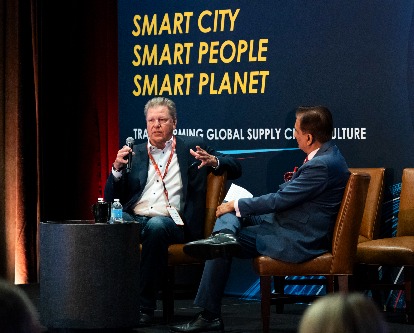
Following his remarks, Senior Vice Dean for Academic Programs Raman Randhawa joined Plenković on stage to moderate questions from Marshall attendees — a rare opportunity for students to converse with a major global leader about the state of the global market and Croatia’s emerging obstacles. Several members of the Marshall community inquired into Croatia’s obstacles to affordable housing, their current trade with China, and the need to invest in education.
“If we don’t invest immediately in our educational programs, we should be having difficulties in competing with those economies and those societies who have longer and stronger educational institutions,” Plenković said, remarking on the relative youth of Croatia as a country, which has only been independent for 32 years.
The final question asked Plenković for advice for students hoping to follow in paths like his. The prime minister left Marshall students with a simple, important message.
“You have this fantastic situation of studying at this prestigious school in a free country. I think the conditions are right to seize the day, or Carpe Diem, in the best way that you can,” Plenković concluded.
RELATED
USC Marshall’s Next Chapter: A Conversation with Interim Dean Andy Call
In this Q&A, Dean Call shares his key priorities and the importance of community in shaping Marshall’s future.
USC Marshall Launches Applied AI in Business Minor
Designed for students of every undergraduate major, the minor explores how artificial intelligence influences innovation, decision-making, and business strategy across industries.
USC Marshall Alumna Named to 2026 Forbes World’s Most Influential CMOs List
Zoom CMO and USC Marshall MBA graduate Kimberly Storin has built her career by embracing new challenges and taking risks.
When Bad Luck Isn’t Random: Understanding ‘Zemblanity’
New research explores how human agency, from mindset to choices, can shape how people and systems create opportunities or preventable misfortune.
VEDA Enters a New Chapter with Appointment of Professor Lan Luo as Director
As blockchain technology matures from a niche experiment into a foundational layer of the global economy, USC Marshall’s VanEck Digital Assets Initiative is positioning itself at the forefront of what comes next.