
- Prospective Students
- Undergraduate Programs
- MBA Programs
- Graduate Accounting Programs
- Specialized Masters Programs
- Executive Education
- Certificate Programs
- PhD Program
- Faculty & Research
- Academic Units
- Centers of Excellence
- Faculty Directory
- Mentoring Resources
- Alumni & Friends
- News and Events
- Alumni Online
- Alumni Groups
- Marshall Partners
- Support Marshall
- Contact Us
- Corporate Connections
- Engagement Opportunities
- Corporate Advisory Board
- Recruit and Hire
- News Room
- Featured Stories
- Upcoming Events
- Faculty in the News
- Marshall News
- About Marshall
- Home
- Faculty & Research
- Centers of Excellence
- Center for International Business Education and Research
- CIBER Projects
- Study Abroad And Experiential Learning
Center for International Business
Education and Research - research projects for sponsoring firms and organizations located around the Pacific Rim,
- faculty teams comprising of Marshall School professors, professors from international partner universities, and international business practitioners,
- required international trips to the Asian and Latin American cities where the sponsoring firms are located,
- eight pre-trip class sessions, specific to the culture and local business practices of the destinations.
- to expose students to one of the profoundly negative consequences of globalization — the illicit trade in human beings; and
- to provide students the opportunity to apply their business skills by assisting not-for-profit organizations in their efforts toward the reduction of human trafficking.
Study Abroad / Experiential Learning
Pacific Rim Education Program (PRIME)
Planning and Observer Travel
PRIME (Pacific Rim Education) is a required experiential learning program for 200+ first-year Marshall MBA students that is comprised of an eight-week-long course (GSBA 580), culminating with a field study trip to Pacific Rim destinations. In 2010, the six destinations were: Hong Kong/Shenzhen, Bangkok/Hanoi, Beijing/Shanghai, Moscow, Sao Paulo/Buenos Aires, and Tokyo.
PRIME improves awareness and understanding of economic, institutional, and cultural issues pertinent to business, markets, policies, and trade in Asia and Latin America. PRIME includes the following components:
PRIME facilitates the development of cross-cultural capabilities among students and faculty. This project is designed to assist MBA students and faculty prepare for the opportunities and challenges of the global marketplace. PRIME enables students to develop technical competence in international business issues by providing an in-country, experiential-learning opportunity for students in the context of country-specific business practices around the Pacific Rim. In addition, the research projects require students to integrate the functional business skills they have developed in their first year of coursework.


CIBER funds are used to finance a combination of faculty planning trips (before the PRIME visit) and junior faculty observers to accompany some of the PRIME study groups. The purpose is to ensure quality preparation for the PRIME visit and enable junior faculty to begin building relationships with Asian and Latin America, in order to create future opportunities for international teaching and research collaboration. CIBER funds will be used to support faculty planning trips and junior faculty observers to accompany some of the PRIME study groups.
PM.Globe
Program Planning and Observer Travel
The PM.Globe "open-economy" macroeconomics course in the MBA Program for Professionals and Managers (MBA P.M.) features an international field trip and research projects. The course is required of all 250+ students enrolled in the program. Students develop a deep knowledge of international economics and business issues during course work at USC. Building on this foundation, groups of 25 to 80 students embark on one of the five field-study trips, In 2010, the destinations were: Shanghai, Singapore/Bangkok, Tokyo/Kyoto, or Seoul/Beijing to observe international business practices during an intensive, week-long field-study trip during spring break. They gain first-hand experience about international business practices and the effects of global economic trends from discussions with non-American executives, academic experts, and government policy makers. PM.Globe aims to help all of the Marshall School part-time MBA students increase their knowledge and understanding of international business environments, to develop their appreciation of cross-cultural differences, and to expose them to international business practices. The course builds both knowledge and skills through a combination of traditional MBA coursework, an international field-study experience, and research projects focused on industry analysis. CIBER funds will be used to support faculty planning trips and junior faculty observers to accompany some of the PM.Globe study groups.
Global Social Entrepreneurship
Towards the Cessation of Human Trafficking- MBAs Working with NGOs in Cambodia
A select group of about 10 Marshall MBA volunteers will work with a non-governmental organization dedicated to reducing trafficking and exploitation of the children living in the slums of Phnom Penh, Cambodia. This project, initiated as a pilot program in 2009, has two primary purposes:
Under the leadership of Joseph Nunes, Associate Professor of Marketing, the volunteers will take an intensive 3-day field visit to Phnom Penh upon the conclusion of their 2011 PRIME trip to Bangkok/Hanoi. Prior to their trip, the student volunteers spend four 1.5 hour class sessions and 2 additional hours of pre-trip work to prepare themselves to be effective in working with the NGO. The Marshall School's medium-term goal is to integrate a social enterprise component into each of the six PRIME destinations, thus, continuing to expand social entrepreneurship opportunities for Marshall students. CIBER funds will help finance students' post-PRIME, in-country travel expenses to participate in the program.
Global Public Health Capacity Building
MBAs Working with NGOs in Latin America
A select group of four MBA student volunteers will embark on a research project, focusing on the healthcare needs of children living in Murambi, a low-income neighborhood in Sao Paulo, Brazil. Led by Sriram Dasu, Associate Professor of Information and Operations Management, over the last three years, the Sao Paolo/Buenos Aires PRIME program has done student research projects to assist Meninon do Murambi, a Brazilian non-profit organization that provides after-school support to children from Murambi. This project will have the MBA volunteers work with Meninon do Murambi to help the NGO better understand the healthcare needs of its community and to help it improve the community's healthcare delivery systems. Their intense 3-day visit is preceded by four 1.5 hour class sessions and 2 additional hours of pre-trip work to prepare the student volunteers. The Marshall student volunteers will work with Masters students in the industrial engineering program at the Instituto de Technologico de Aeronautica (ITA), San Jose de Campos, Brazil, whose faculty and students are involved in assessing and improving health-care delivery systems. Initiated as a pilot program in 2009, this project will take place upon the conclusion of the Sao Paulo/Buenos Aires 2011 PRIME trip. This project helps to expand social entrepreneurship opportunities for Marshall School students. CIBER funds will help finance students' post-PRIME, in-country travel expenses to participate in the program.
Global Internship Program
Undergraduate Summer Internships in China
This project is an eight-week summer internship program in Beijing and Shanghai for selected undergraduate students from the Marshall School's Global Leadership Program (GLP) seminar. GLP, which is open by invitation only to the most academically-talented students in Marshall’s freshman class, attracts about 100 students in the Spring semester. This course, which includes lectures from business school faculty and China experts from Letters, Arts & Sciences, as well as from China business practitioners, includes a required 10-day experiential learning trip to China during Spring Break. The business and government internships provide students with the unique experiential opportunity to further their learning about Chinese business practices and culture, as well as develop their own capabilities through living and working abroad. CIBER funds are used to finance the living expenses of the interns.
Undergraduate Summer Internships in Indonesia
This is an eight-week summer internship program in Jakarta for USC undergraduate students. CIBER's Indonesia internship program will provide students with unique opportunities to learn about business practices, social issues, and Indonesian culture, as well as develop their capabilities to live and work in Indonesia, a new democracy that has the world's largest Muslim population. CIBER funds will be used to help finance the living expenses of the interns.
Global Health & Business
Undergraduate Student Presentation Competition
Focusing on the thematic area of “global health and business”, this project will be undertaken as a required component in 10 sections of the Marshall School’s BUAD 302 course on “Communication Strategy in Business”. Seventy-two teams of 4 undergraduate students will compete to develop the best presentation on “global health and business”, which will be selected by a panel of faculty and health care industry experts. CIBER funds will be used to award the top two 2 teams with an incentive prize, to be presented at a Pacific Cities Sustainability Initiative (PCSI) conference, which is co-produced by the Asia Society Centers of Northern & Southern California and USC and UCLA CIBERs.
Undergraduate Tour of Border Factories
Maquiladoras in Tijuana
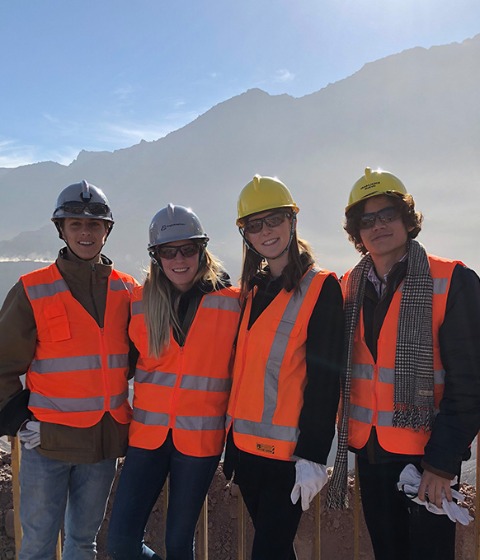
This study-trip exposes about 200 undergraduate business students to international business practices of maquiladoras (foreign-owned export facilities) located in Tijuana, Mexico. As a critical component of three courses, MOR 492: "Global Strategy", FBE 462: "International Finance" and FBE 464: "International Trade and Finance", this project allows students to examine US-Mexico trade issues and to conceptualize a strategy for businesses to enter a foreign market. The project provides them with the socio-economic context from which these facilities emerged, and specifically, information about business trends in Mexico. The program includes intensive site visits to five maquiladoras in the Tijuana corridor over an extended weekend during both the Fall and Spring semesters. CIBER funds will help finance part of the students' in-county travel expenses.
Experiential Corporate Environment Learning (ExCEL) Program
for Undergraduate Business Student
The ExCEL program, which is implemented in partnership between the Marshall School and the undergraduate student-led Asian American Business Association, takes about 30 undergraduate students on an eight to ten day experiential business study trip to a Pacific Rim commercial hub during Spring break to learn about the culture, economy and business practices of the region being visited. By design, about one-third of the students are from non-business majors, which stimulates the business school students to learn about the cross-cultural, public administration and foreign policy aspects of international business and provides the non-business studens with the opportunity to develop first-hand knowledge about international business. CIBER funds are used to finance a portion of the students' in-country travel.
- RSS
University of Southern California Marshall School of Business | Copyright 2001 - 2013 | Privacy Policy