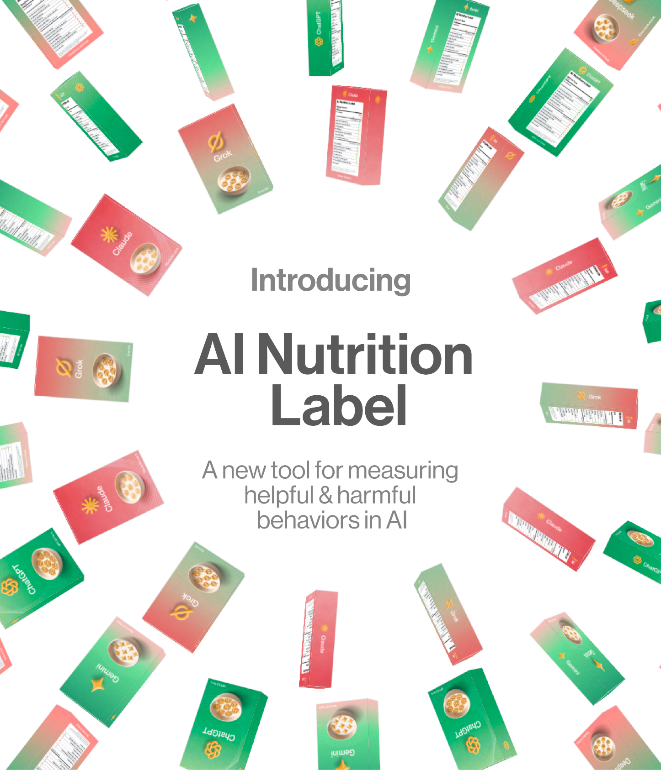
Nutrition labels have long helped consumers understand what they’re putting into their bodies. Now, a new framework applies a similar approach to AI, giving people a clearer view of how the AI models they use may affect their wellbeing.
Co-developed by researchers from USC Marshall’s Neely Center for Ethical Leadership and Decision Making, the MIT Media Lab’s Advancing Humans with AI program, UC Berkeley Haas, and the Psychology of Technology Institute, ImpactBench is an expert-guided, open and evolving evaluation platform that translates benchmark results into accessible, consumer-facing AI Nutrition Labels.
“Nutrition labels tell people what’s inside the food they eat, yet the AI systems increasingly shaping how people think, decide, and connect come with no equivalent,” said Pattie Maes, Germeshausen Professor of Media Arts and Sciences and co-lead of the AHA program at the MIT Media Lab.
The platform currently evaluates leading frontier AI models over 800 metrics and 26 expert-built benchmarks spanning physical, psychological, and social impact. That data is then translated into AI Nutrition Labels, simple, at-a-glance ratings, modeled on food nutrition labels, showing how a given AI system scores on avoiding harm and promoting wellbeing.
ImpactBench measures negative behaviors in models such as factual hallucination, sycophancy, and toxicity, as well as beneficial behaviors like promoting user agency, and supporting human wellbeing. The open platform also invites researchers, domain experts, and organizations to contribute new benchmarks, validate existing measures, and help shape how results are presented.
“No single institution can fully define the many ways that AI will impact people,” said Ravi Iyer, managing director of the Neely Center at USC Marshall. “Creating an open platform that allows diverse clinicians, researchers, and scholars to take advantage of the latest benchmarking innovations will allow society to meaningfully participate in AI’s future.”
If ImpactBench provides the open infrastructure for researchers and institutions to evaluate AI systems, AI Nutrition Labels make those findings accessible to the public in a familiar, easy-to-understand format.
As AI becomes increasingly embedded in how people work, learn, communicate and make decisions, ImpactBench shifts evaluation beyond traditional measures of accuracy, speed and performance to a more fundamental question: What is the human impact of AI?
“AI capabilities matter, but these models don’t just answer our questions; they also shape how we think, who we trust, and how confident we feel in our own decisions,” said Nathanael Fast, professor and director of the Neely Center at USC Marshall and co-director of the Psychology of Technology Institute. “ImpactBench measures and tracks psychological effects like these so we can build AI that fosters human flourishing.”
For the full press release, click here.