Hoag Foundation President Caroline Pereira on Philanthropy, Executive Leadership, and Purpose-Driven Work
As president of the Hoag Hospital Foundation, Caroline Pereira EMBA ’17 is working to get care to thousands of California patients.
PRIME Trip Gives MBA Students Chance to Explore Media Industries in Asia
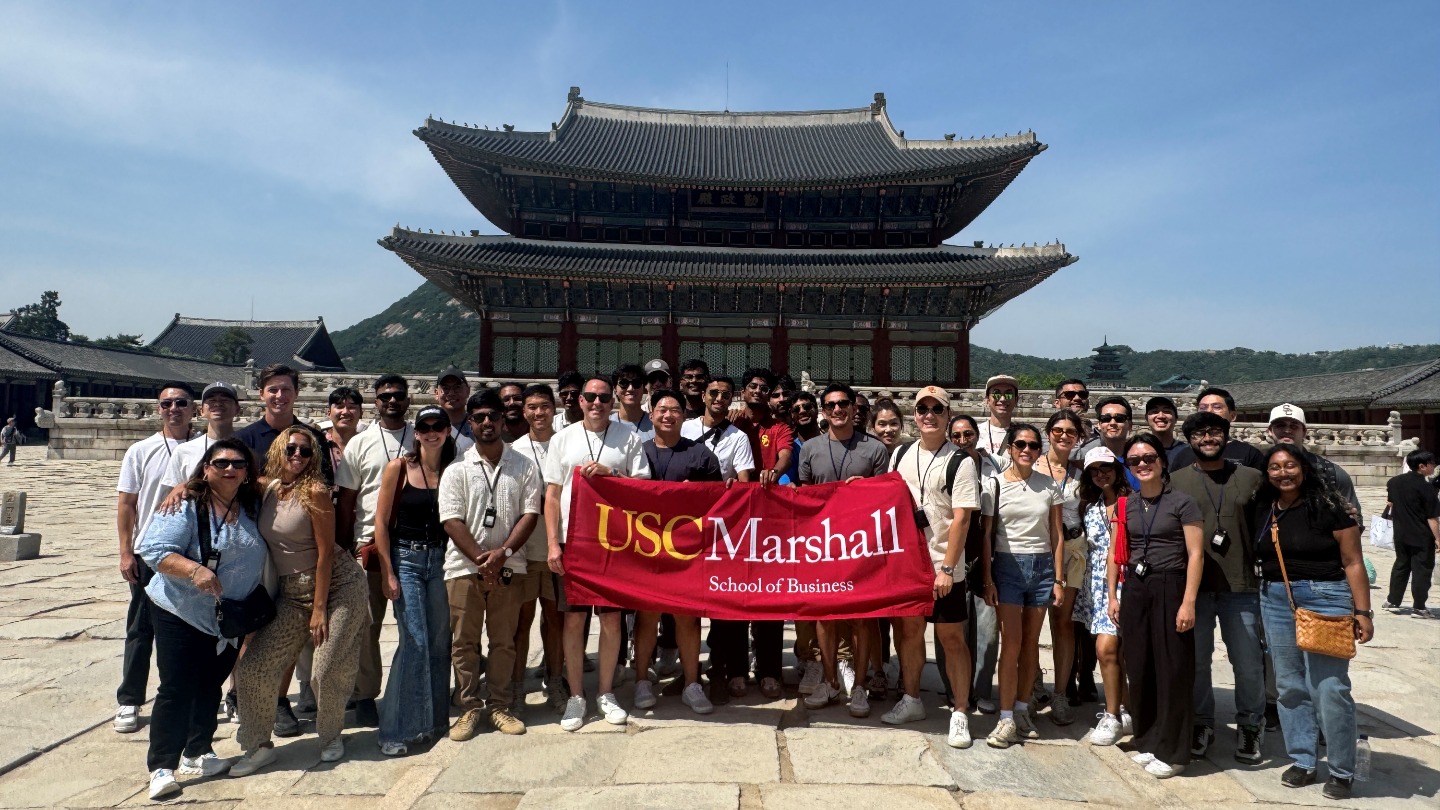
FTMBA students stand in front of Gyeongbok Palace in South Korea.
[Photo courtesy of Abrams]
This past spring, a cohort of USC Marshall Full-Time MBA (FTMBA) students traveled to Seoul and Hong Kong for an immersive look at their entertainment and media industries. The trip, a feature of GSBA 582: The Global Context of International Business, not only provided students with access to companies like CJ ENM Studios, bemyfriends, and Hong Kong Disneyland, but also gave them a chance to present real-world consulting projects to executives.
Scott Abrams, academic director of the FTMBA program and the course instructor, sees international experiences like PRIME as essential preparation for MBA students entering increasingly globalized industries.
“We live in a global world, and students have to know what else is out there,” Abrams said. “We’re selling products abroad or we’re buying things from abroad. You can’t just be focused on one isolated country.”
The PRIME global experience is a requirement for Marshall’s FTMBA students. For their trip, they could select from various locations, such as Singapore, Thailand, Japan, and the United Kingdom. Abrams’ class included a mix of professional aspirations, from those who hoped to conduct business in South Korea and Hong Kong to those interested in international media markets.
“I chose this PRIME trip because it focused on global entertainment,” said Reagan Seiler, a second-year MBA student. “I want to build a career in entertainment, and seeing the industry up close in Seoul and Hong Kong showed me how East Asian entertainment works and how it shapes the U.S. market. That perspective will matter more and more as the industry becomes more global.”
Preparation for the trip began long before takeoff. In the classroom, Abrams established four main objectives for his students: understand how global media firms compete; understand South Korea’s and Hong Kong’s respective history, culture, and place in the media landscape; learn how to operate in a global context through a hands-on consulting project; and learn through immersion in the regions themselves.
Throughout the course, students examined the histories of both South Korea and Hong Kong, while also exploring the larger context of the region’s film, television, and media markets. Hong Kong, the students learned, has a deep history of film success, most prominently highlighted by the popularity of Bruce Lee, Jackie Chan, and movies from director John Woo. In addition to South Korea’s own film industry, the explosion of K-pop and K-dramas has produced a new wave of international interest in the country’s market.
Still, Abrams says no textbook can measure up to the experience of being there in person.
“I tried to give them a preview of what we were going to learn, but then again, you can’t really capture it,” Abrams said. “Being on the ground, seeing the sights, smelling the smells — you can't replicate that in the classroom.”
The class also composed small-group projects in coordination with companies in Seoul and Hong Kong. Teams of students highlighted issues facing these businesses and prepared well-researched solutions for real-world implementation. The groups then presented slide decks during company visits, discussing background and analyses while offering key recommendations.
Max Goodley, a second-year MBA student, recalled providing real-world solutions to one company’s president and executives at CJ ENM, South Korea’s top film and television studio.
“Getting to interface with a major international studio head was an incredibly nerve-wracking experience, but I was able to grow professionally because of it,” said Goodley.
These visits also opened students’ eyes to the subtle differences between American, South Korean, and Hong Kong business customs. From the formalities of networking to the subtleties of professional communication, Seiler says she and her cohort absorbed an entirely new approach to organizational etiquette.
“In Korea, I saw how much care companies put into hosting guests,” Seiler said. “In Hong Kong, I saw the mutual respect between executives and their employees. And across the region, I saw how East Asian companies are leading the way in building fandom. I’ve kept thinking about all three since the trip, and they’ll shape how I lead teams, build relationships, and connect with audiences in my career.”
Over the week, students were exposed to a range of business approaches and practices. In Seoul, the cohort met executives at the talent management firm bemyfriends, beauty influencer business group and creative management agency Leferi, stationery company and developer of creator economy applications Jong Ie Nara, and entertainment and mass media company CJ ENM Studios, one of Korea’s largest media conglomerates.
In Hong Kong, students visited media company Random Art Workshop, Cosmopolitan Hong Kong, and Hong Kong Disneyland.
Between these meetings, the consulting projects, and the immersion of the program, Goodley believes the PRIME trip will carry benefits for him well into his career.
“The understanding of the media landscape in South Korea and Hong Kong will enable me to consider international growth strategies more effectively in these regions, and the way they conduct business,” Goodley said. “I will also apply what I learned from presenting to executives to my career moving forward.”
For Seiler and her classmates, the PRIME trip wasn’t just a bonus of the MBA program, but a cornerstone of the school’s global approach to education.
“PRIME was one of the main reasons I chose USC Marshall,” Seiler said. “When a program makes global travel a requirement, it shows it takes seriously how international business has become. Working in another market, even briefly, pushed me to adapt, stay curious, and see my own assumptions from a new angle … I came home a more well-rounded person and a better future leader, and that has made my MBA feel worthwhile.”
RELATED
Hoag Foundation President Caroline Pereira on Philanthropy, Executive Leadership, and Purpose-Driven Work
As president of the Hoag Hospital Foundation, Caroline Pereira EMBA ’17 is working to get care to thousands of California patients.
A Week in the Life of a Marshall MBA Student
From class to tailgating, second-year MBA student Maddie Gissler describes her typical week at the USC Marshall School of Business
Quoted: Greg Patton in China Daily
Patton explains why native English speakers may have a difficult time learning Mandarin.
Quoted: John Matsusaka in Flatwater Free Press
In light of Nebraska’s proposed restrictions on ballot measure petitioning, Matsusaka explains that it’s hard to tell whether these proposals are about the integrity of the process or are convenient attempts to stop certain ballot measures.
Trojan Family at Work: How One MBA Student Turned a Career Setback into a New Opportunity
Just before graduation Hannah Foley MBA ’25 learned her full-time offer had been delayed. As she considered her next move, the Trojan Family helped open the door to a new opportunity.