Quoted: Shaun Harper in the LA Times
Harper discusses his new MBA class, the Business of Beyonce.
Human Performance and AI in Sports Analytics Minor Combines Practical Skills with Data Analysis
The interdisciplinary program between USC Marshall and USC Dornsife combines AI implementation with the human skills needed to succeed in the modern sport landscape.
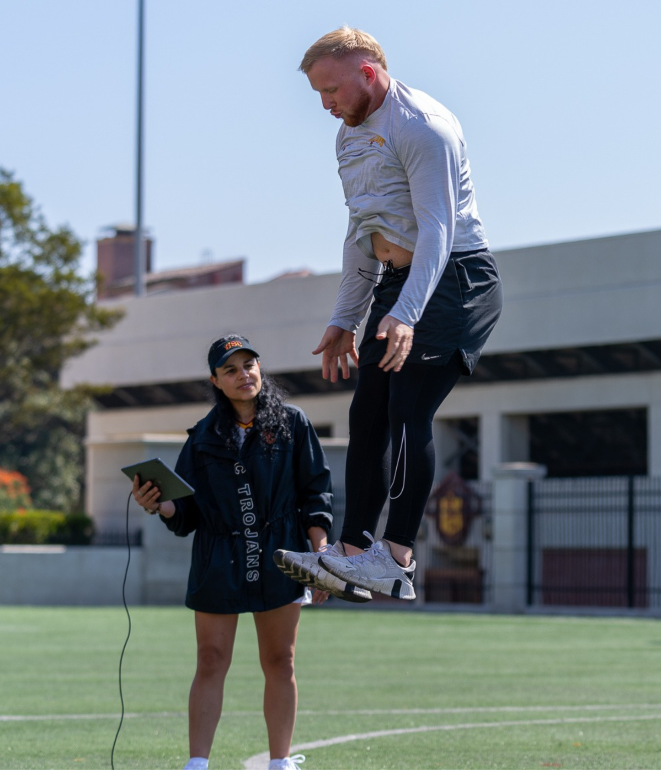
Lorena Martin, Founder and Director of the Trojans Sports Research Lab
[USC Photo / Grayson Adler
As AI reshapes the sports industry, the USC Marshall School of Business and the USC Dornsife College of Letters, Arts, and Sciences is exposing students to these emerging technologies while also providing them with the necessary soft skills to engage athletes and develop performance.
The Human Performance and AI in Sports Analytics minor launched this fall and was spearheaded and co-developed by Lorena Martin, assistant professor of clinical data sciences and operations and founder of the Trojans Sports Research Lab (TSRL) and Gioia Polidori at USC Dornsife. The 18-unit minor spans courses at both schools and is open to all USC students, particularly those interested in sports-related careers.
“AI is automating a lot of roles in many industries, all industries,” Martin observed. “I think one of the domains that is going to be still very profitable and that we’re going to need human capital, not just AI machines, is sports.”
In addition to classroom learning, the minor takes advantage of the university’s proximity to Los Angeles, a global epicenter for sports and entertainment. The region is home to three professional soccer teams, three basketball teams, two baseball teams, two football teams, a professional hockey team, and major college athletics. The city also recently hosted multiple matches in the 2026 FIFA World Cup, and will host Super Bowl LXI in 2027 and the Olympics in 2028.
Martin believes USC is uniquely positioned to tap into these upcoming events and the city’s role as a leader in the sports world, benefiting students seeking local opportunities.
“We’re in the mecca of sports,” Martin said. “Our students can be vetted for openings that maybe others will not be as prepared for. They can come into the pool that is very local.”
According to Martin, the minor covers four domains: the sports industry, analytics, AI, and soft skills. The multifaceted nature of the program aims to provide Trojans with a competitive edge in the job market, giving them a leg up as they pursue sports-related careers.
“The people that [Trojans] are going to go up against usually are either trained only in the sports domain or only from the data science analytics domain,” Martin explained. “In the minor, we’re leveraging analytics and AI for sports.”
Martin argues that it’s not enough for students to master either data collection or physiological analysis. To succeed in the sports domain, she says Trojans must have competency in the human aspects of a sport while also understanding how data can improve performance. She believes the minor provides a well-rounded examination of both areas.
The people that [Trojans] are going to go up against usually are either trained only in the sports domain or only from the data science analytics domain. In the minor, we’re leveraging analytics and AI for sports.
— Lorena Martin
Assistant Professor of Clinical Data Sciences and Operations / Founder and Director, Trojans Sports Research Lab
“People that analyze the data correctly — they may be great with data science and machine learning and data engineering, but if they don’t understand what the context is, they can make very, very costly mistakes in sports,” Martin said.
One of the required courses, DSO 484: Applied AI in Sports Research, offers practical experience working with a professional, collegiate, or intramural sports team, or a sports technology company. Martin, who formerly worked as the director of sports performance analytics for the Los Angeles Lakers, says DSO 484 allows students to see the day-to-day realities of data collection in the sports world, beyond what they can read about it in a textbook or academic journal.
“You’re running after the athlete trying to collect the data. They want to go and eat. What do you do?” Martin said. “Then when communicating the findings to a Coach or GM, what are the soft skills you need to have? [To prepare students], we created a workshop on soft skills to work in pro sports.”
While Martin believes the on-field/on-court product will be largely unchanged by the advent of artificial intelligence, she believes that the technology will still play a large role in behind-the-scenes operations and decision-making. In DSO 478: Sports Data Science, AI, and Management, the class will employ AI to analyze sports trends and develop methods to optimize athlete performance.
In her years working in the industry, Martin has seen colleagues struggle to integrate new technology. She plans to keep her students working on the cutting edge.
“A lot of times what I see is individuals that know the domain, but they don’t know what data to collect or how to analyze it,” Martin said. “They don’t know the analytics. They don’t know how to leverage AI. They don’t know when to trust AI and when not to trust AI.”
For more information about the minor and to learn more about the required courses, please click here. Registration is now open.
RELATED
Quoted: Shaun Harper in the LA Times
Harper discusses his new MBA class, the Business of Beyonce.
Former Navy SEAL Flourishes in Telecom Industry
After serving his country in the Navy SEALS, Chris Sambar MBA ’02 used his graduate education at USC Marshall to find success in a new profession.
Beyond Abstract Reasoning: Leveling the Playing Field in Aptitude Testing
New research suggests that traditional aptitude tests may overlook social-relational skills developed through working-class experiences, pointing to more inclusive ways to assess logical reasoning.
Quoted: Nick Vyas in Inc.
Vyas explains how larger retailers protect themselves from market volatility, while smaller suppliers must absord higher shipping rates.
2026 Energy Business Summit Addresses AI and Energy Security
Hosted by the Zage Business of Energy Initiative, the annual summit gathered industry experts for discussions about the role of data centers, energy policy, and the impact of the war in the Middle East.