Former Navy SEAL Flourishes in Telecom Industry
After serving his country in the Navy SEALS, Chris Sambar MBA ’02 used his graduate education at USC Marshall to find success in a new profession.
Aim High: The Two-Word Lesson That Sparked a USC Marshall EMBA Student’s Next Venture
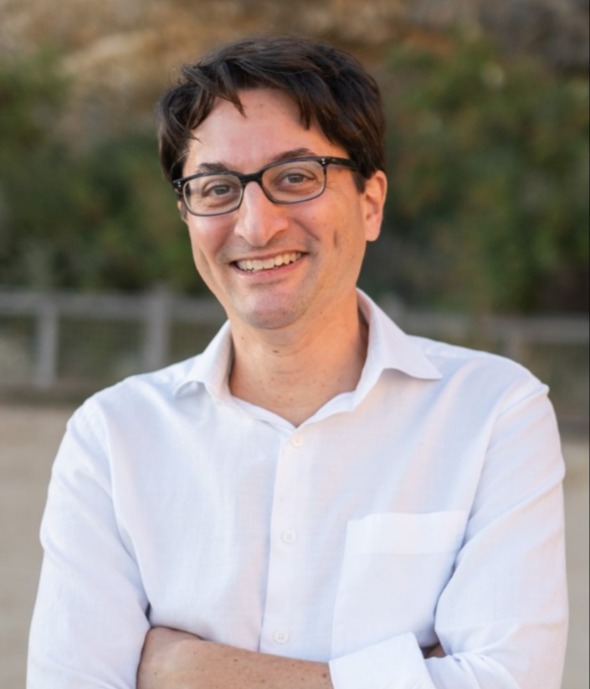
Andrey Chabanov had already built and sold companies before he ever set foot at USC Marshall. Then a professor’s advice convinced him he wasn't finished yet.
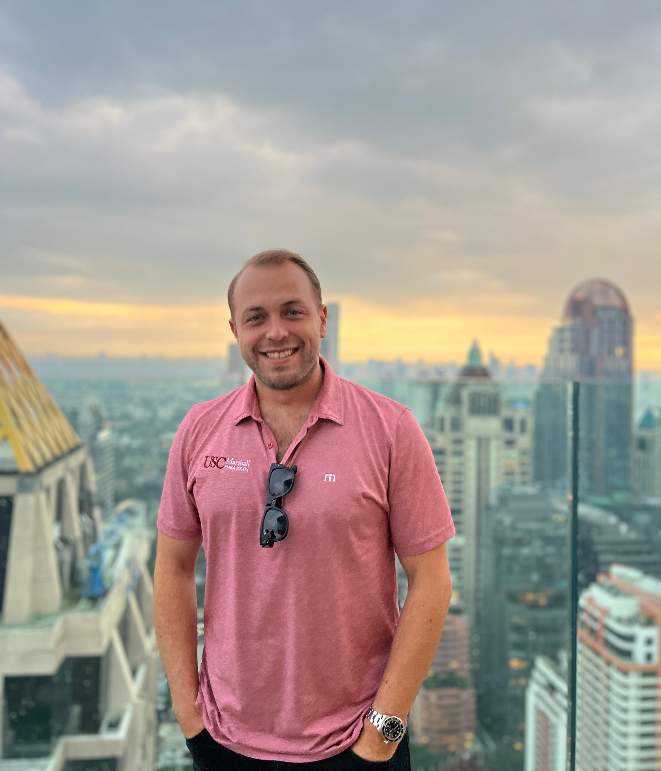
When Andrey Chabanov looks back on his time as an Executive MBA (EMBA) student at USC Marshall, these two words — advice from Greg Patton, professor of clinical business communication to students at their first residential retreat in Rancho Bernardo — turned out to be the push he needed to launch the next chapter of his career.
At the time, Chabanov was the vice president of product at iTrustCapital, an award-winning fintech platform for digital assets he helped build into a $1.3 billion company. Still, as he surveyed his EMBA cohort — nearly 60 students with decades of experience in banking, medicine, and warehousing — he began to wonder what more he could achieve.
“There I was, sitting among executives, doctors, surgeons, people who run global companies, and I thought, ‘Am I selling myself short?’” Chabanov said.
Driven by his classmates, Chabanov co-founded Wellspring, a high-yield savings app designed to give everyday investors access to better returns on their savings.
A Builder from the Start
Chabanov’s entrepreneurial streak started early. As a kid in Ukraine, his very first venture was a windsurfing school.
“From a young age, I’ve always been interested in creating value and scaling my abilities to do something that I can offer to more than one person,” Chabanov recalled.
Chabanov’s ambition carried into adulthood. After emigrating to the U.S. and graduating from UC Santa Barbara, he joined the crowdfunding platform CoinStarter as a founding engineer, helping raise $200 million for more than 150 crypto startups. Riding the logistics boom of the COVID era, he also launched Trelp, a crowd-sourcing app that helps truck drivers find exact pickup and drop-off locations and nearby parking.
Then, in 2021, a friend reached out from iTrustCapital, which was pioneering a bold new concept: allowing investors to hold crypto and other digital assets inside a retirement account. In just a few short years, Chabanov helped scale iTrust into the largest provider of its kind. Still, he wondered what else might be possible at USC Marshall, a place where he could learn with and from the best.
“The faculty at Marshall ... They are professionals who know firsthand what it's like to build, run, and sell startups.” Chabanov said, noting that many came from careers in venture capital, private equity, and marketing.
The EMBA format was deliberate, as well: “I didn’t want to step out of the industry for two years,” Chabanov said. “I wanted to apply what I was learning in real time while still operating.”
Two years in this program — it can be life-changing. You have the support of an amazing institution, and if you don’t hold on too tightly and actually do aim high, you’ll be amazed at how high you can go.
— Andrey Chabanov
Chief Operating Officer, Alphapoint
Marshall, he added, stood out for its entrepreneurship ecosystem, the Lloyd Greif Center of Entrepreneurial Studies, its incubator, the Techstars pre-accelerator, and the Trojan network. He also singled out operator-faculty like Dan Wadhwani, the Greif Center’s director, whose Founder’s Dilemmas course he calls one of the most useful he took.
“Between him and Professor Patton, I had two people at Marshall who genuinely pushed me to think bigger,” he said.
Turning a Hackathon into a Company
The first step towards this new venture came in May 2024 when Chabanov and his co-founders, Trevor Hoffman and Slava Chabanov, interviewed with Paul Orlando, director of the USC Marshall/Greif Incubator, and were invited to join its summer program.
That June, just weeks after joining the Greif Incubator, the team entered the Consensus 2024 Hackathon, the largest annual gathering of crypto enthusiasts. In only a day and a half, the team built a payment infrastructure inside Telegram that won them the competition’s track sponsored by Stellar, the blockchain network that would go on to back their company as an early investor. It was the first working version of Wellspring.
Within weeks of launching a beta that July and with no marketing spend, the product processed more than $300,000 in transactions from users in 50 countries.
Wellspring, Chabanov explained, unlocks complex, over-collateralized lending markets on the blockchain and makes them accessible to everyday users.
“We give everybody a U.S. bank account, but under the hood, we do all sorts of piping, in a compliant way, to make sure clients get a higher return on their deposits,” he said.
They soon received backing from the Stellar Development Foundation and Draper University Ventures, a milestone Chabanov credits directly to the ecosystem USC Marshall built around them.
“Programs like Techstars and the Greif Startup Incubator provided invaluable resources, mentorship, and connections with seasoned entrepreneurs and investors, which helped us sharpen our vision and build a scalable business model,” Chabanov said.
That groundwork paid off. In March 2025, Poets&Quants named Wellspring one of the most disruptive MBA startups, and the co-founders completed the USC and Techstars pre-accelerator. In March 2026, Chabanov and the Wellspring team took their work to AlphaPoint, a 13-year-old digital asset infrastructure company whose technology powers exchanges, wallets, and payment platforms for banks, governments, and financial institutions worldwide.
What's Next
Two years after enrolling in Marshall’s EMBA, Chabanov believes he’s operating with greater ambition than ever before. After a senior role at AlphaPoint Global, he’s now preparing his next chapter, with more news to come.
Whatever form Wellspring takes, Chabanov says what he learned at Marshall will undoubtedly inform its path. It’s the same lesson he now passes on to prospective students, echoing Professor Patton’s own advice.
“Two years in this program — it can be life-changing,” Chabanov said. “You have the support of an amazing institution, and if you don’t hold on too tightly and actually do aim high, you’ll be amazed at how high you can go.”
RELATED
Former Navy SEAL Flourishes in Telecom Industry
After serving his country in the Navy SEALS, Chris Sambar MBA ’02 used his graduate education at USC Marshall to find success in a new profession.
Beyond Abstract Reasoning: Leveling the Playing Field in Aptitude Testing
New research suggests that traditional aptitude tests may overlook social-relational skills developed through working-class experiences, pointing to more inclusive ways to assess logical reasoning.
2026 Energy Business Summit Addresses AI and Energy Security
Hosted by the Zage Business of Energy Initiative, the annual summit gathered industry experts for discussions about the role of data centers, energy policy, and the impact of the war in the Middle East.
Educator Pivots to Salesforce Success
Alli Jaeggi MBA ’20 is still using her experience as a high school educator to flourish as director of product marketing at Salesforce.
How a Disney Senior Vice President Leaned on Classmates to Become a Better Leader
Patrick Finnegan ’93, MBA ’10 describes how the EMBA program set him up for success at Disney Parks and taught him how to lead a large organization.